
When Conscience Selects Its Victims

When Conscience Selects Its Victims
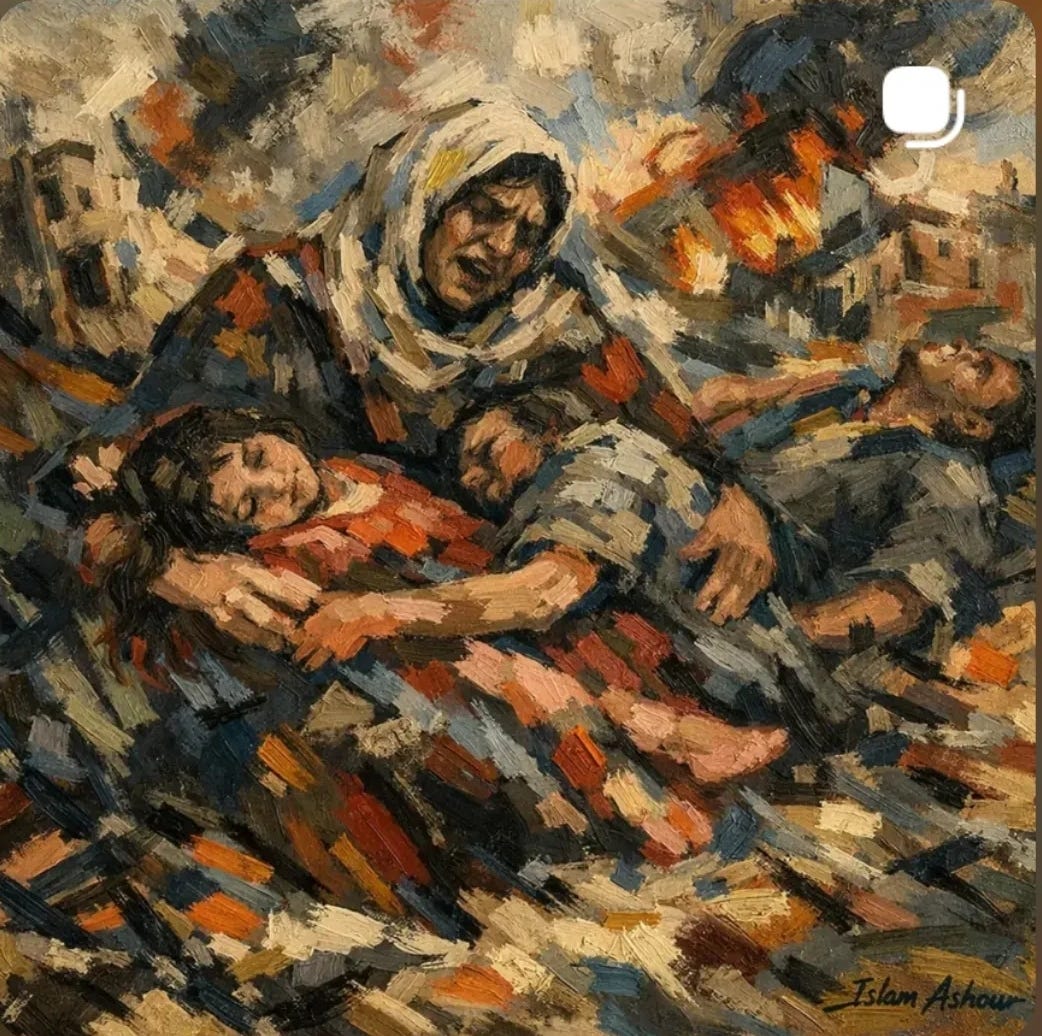
An artwork by the artist Islam Ashour from Gaza.
Morality is not a passport.
It is not stamped at borders, nor exchanged like currency between two tribes.
It is something simpler — and more dangerous:
that a human being remains human
even when the name, the flag, the religion, and the direction the bullets came from are different.
Morality is indivisible.
It cannot be split into blood that deserves mourning
and blood that belongs in a footnote.
Whoever adjusts the scale of conscience according to affiliation
is not defending the truth —
but defending themselves from the truth.
In this world,
people have mastered tailoring morality like a war uniform:
tightening it around their enemies
and loosening it around their own sins.
Racism, too,
is nothing more than a frightened retreat
around a small mirror
we stare into long enough
to convince ourselves the whole world looks like our faces.
And all wars are evil.
There is no clean war,
no noble blood,
no ethical bullet.
The height of tragedy
is that the victim, after all this pain,
goes searching for another victim
to place upon their shoulders the burden of defeat and the sins of humanity.
And only then
does the executioner burst out laughing.
For what could he want more
than a world
where victims divide the roles among themselves?
The truth — as if spoken by an ancient stone — is simple and harsh:
If justice requires an identity,
it is not justice.
And if conscience selects its victims,
it is not conscience.
It is merely
elegant rhetoric
for dividing humanity.